The kitchen linoleum caught the light in a thin, cold strip near the pantry. I stood by the coffee maker, hand resting on the ceramic dog-bone jar, listening to the steady, rhythmic sound of claws clicking against the floor. Mabel was moving in a slow, aimless circle, her nails tapping out a pattern that felt frantic. I told myself she was just anxious about the evening routine. I watched her pass the rug runner three times, her head low, her tail tucked in a way that looked like worry.
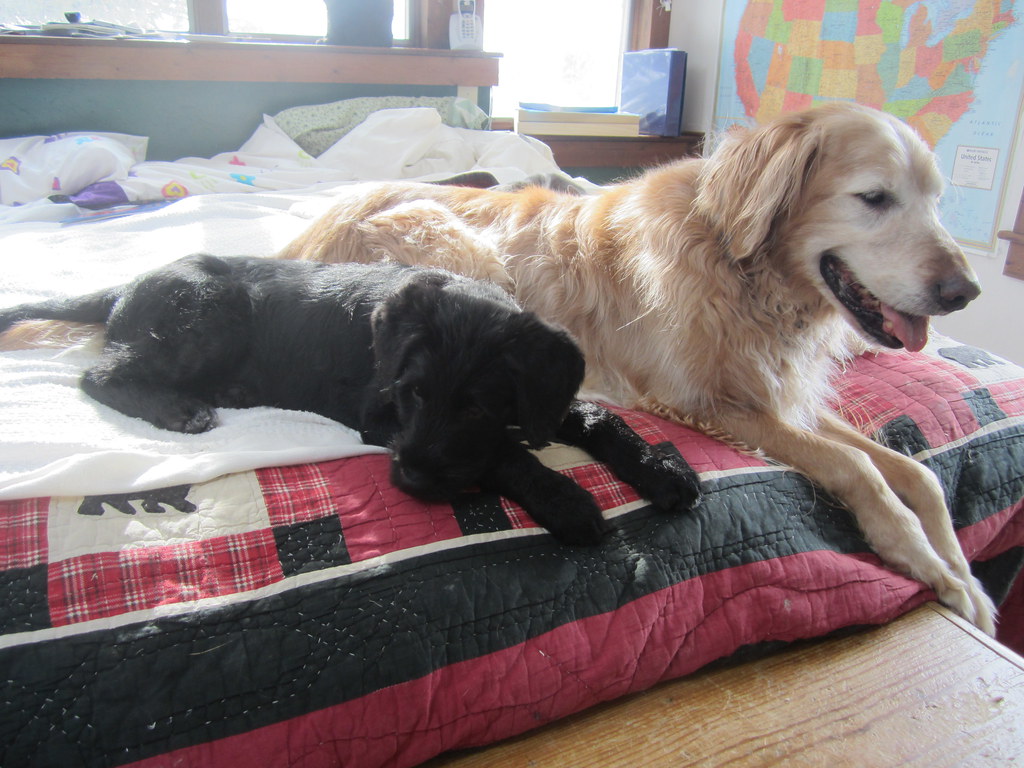
Walter lay near the back door, his breathing deep and steady, watching her with a confusion that mirrored my own. I did not know yet that the pacing had a different source entirely.
Why I called it anxiety
Three weeks ago, I stood by the kitchen counter and watched Mabel pace the length of the rug runner in the hallway. She moved with a repetitive, rhythmic gait that felt urgent. I told myself it was simple anxiety. I assumed she felt unsettled by the arrival of a new senior foster, so I tried closing the bedroom door to create a quiet sanctuary for her. That failed to change her path by even an inch. She simply navigated around the closed door and continued her loop.
I expected her to show the usual signs of distress—panting, whining, or looking to me for reassurance—but she did none of those things. Instead, she seemed entirely focused on the floor, her nose twitching at the rug runner as if she were searching for something that was not there. The surprise was not in her agitation, but in her detachment. She was not asking for my comfort; she was trapped in a mechanical, internal loop. When I finally sat on the floor near the leash hook, she walked past me as if I were a piece of furniture. It was then that I realized this was not a behavioral reaction to a new dog. It was a neurological ghost, a repetitive motion that existed apart from her personality.
What the notebook showed me
I sat at the kitchen table last Tuesday morning with my open notebook, watching the way the light hit the rug runner near the pantry. I had tried increasing the length of our evening strolls, thinking that physical exhaustion would quiet the pacing, but it only made her more restless in the hallway. My notes from that week are messy, filled with ink smudges and crossed-out guesses about her stress levels. I expected her to be panting or seeking me out for comfort, but the micro-surprise was how she moved instead. She did not want my attention. She moved in a soft, rhythmic loop that ignored the house entirely.

Mabel has a long-standing habit of choosing to sleep in front of the back door, where the floor is coolest. When the pacing began, she would stop her loop just long enough to glance at that door, then turn back toward the kitchen island. It was not the frantic energy of a dog who is anxious about a storm or a visitor. It was something else, something that did not belong to the usual rhythm of our home. I kept writing, trying to catch the difference between a dog who is worried and a dog who is simply unmoored.
Changing the environment instead
Last Tuesday morning, I tried keeping the hallway lights dim to see if that would settle her. I thought it would mimic a den and provide comfort, but she only grew more agitated. She began to pace the perimeter of the living room, her nails clicking against the hardwood floor in a way that made my chest tighten. I expected her to find a corner and sleep, but she just kept moving, circling the rug runner near the fireplace as if she were looking for an exit that did not exist.
I realized then that my focus on her internal state was missing the physical reality of her confusion. I had been treating her movement as a behavior to be quieted, rather than a symptom of a house that had become too complex for her current vision. I moved the heavy oak coffee table three inches to the left, thinking it would clear her path, but that only caused her to bump into the corner of the sofa. It was a mistake to think I could fix her confusion with furniture placement.
Instead, I started to use small, high-contrast visual markers. I placed a bright blue piece of painter tape on the edge of the hallway transition and a small, textured mat by the back door. The goal was to provide a sensory anchor that she could feel under her paws. Watching her pause at the edge of the rug runner instead of drifting aimlessly felt like a shift in our entire rhythm. It was not a cure, but it was a way to make the space readable for her again. I sat in my reading chair and watched her finally lie down near the radiator, her breathing slowing until the room felt quiet.
Finding the middle ground
I look at the rug runner in the hallway now and I see the space where she used to pace, back when I was convinced it was only nerves. It is not that I ignore the anxiety, but I have learned to look for the physical rhythm that hides beneath it. When she circles the kitchen island, I watch her eyes and her gait instead of just waiting for her to settle.
There is a quiet, ordinary space between assuming a dog is worried and realizing they are simply lost in their own head. I keep my notebook on the counter corner near the coffee maker, ready to catch the moments when she seems to drift. It is not about fixing the pacing. It is about making the house a place where she can be confused without being frightened.
I leave the lamp by the reading chair on a little longer in the evenings. The house feels softer when I stop trying to label every movement. It is just a quieter way to live.
Why anxiety was such a tempting label
Anxiety gave me action items I already understood. More decompression. More exercise. Softer music. A calmer evening. Those are all lovely things, and some of them were still helpful, but I was using the word "anxiety" almost like a decoy. It kept me from asking whether the pacing had a lost quality to it instead of a nervous quality.
When I looked closer, I noticed she was not pacing away from something. She was not startled, hypervigilant, or looking for reassurance in the way I expected. She was just moving without landing. She would enter the room, scan it, leave, re-enter, and then pause by the same corner like it might reveal what she had forgotten.
I also made the classic mistake of trying to fix it with bigger effort. I added an extra loop to our walk one afternoon thinking she needed to burn something off. She came home more taxed, slept poorly, and paced longer that night. That was humbling. It taught me that more output is not the same thing as better support.
What helped once I asked a better question
- I moved our evening walk earlier and made it shorter.
- I dimmed the house more gradually before bedtime.
- I kept late visitors and kitchen commotion to a minimum.
- I watched whether pacing came with confusion about doors, bowls, or beds.
That last point is what finally moved me out of the anxiety story. The pacing was not living alone. It was keeping company with other tiny signs. Once I saw that, I could make home easier instead of just trying to tire her out.